
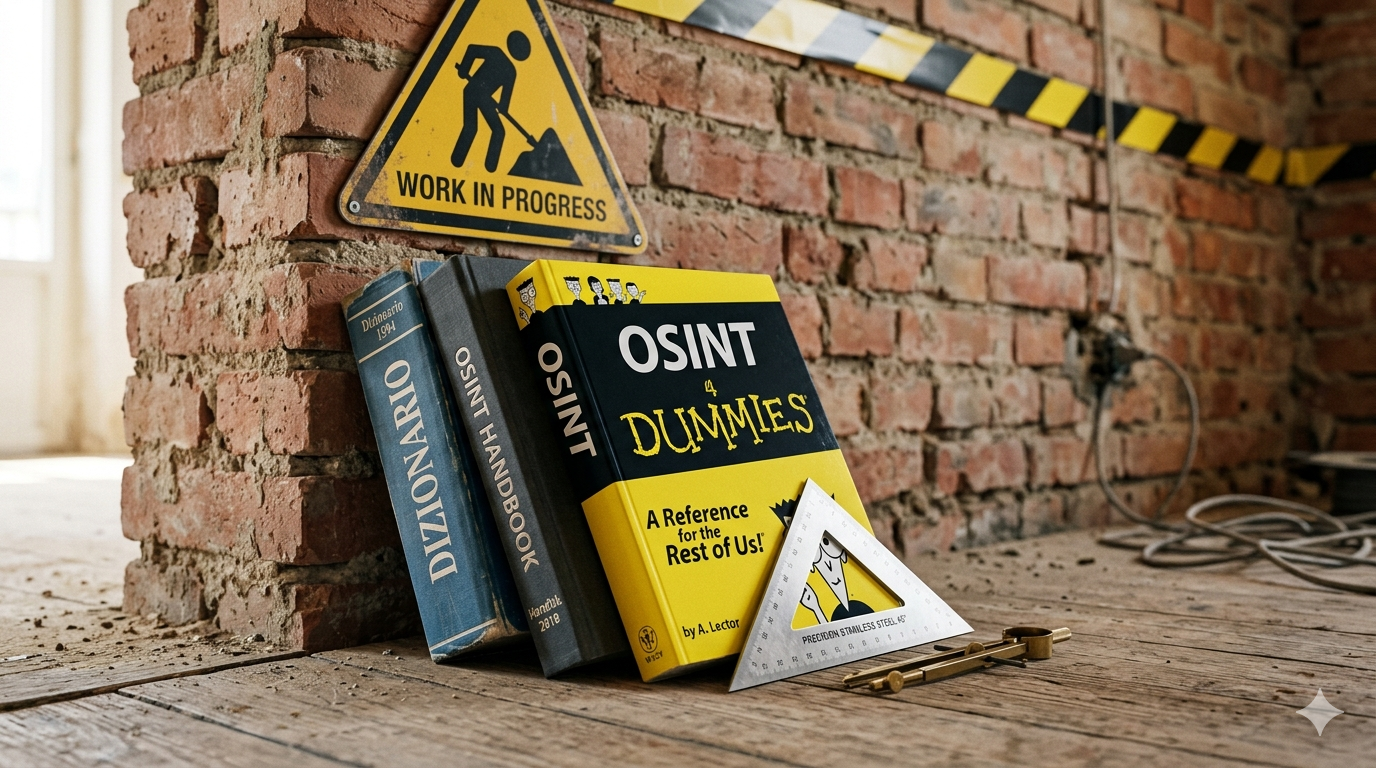
A blog about OSINT that doesn’t get updated already has one foot in the grave. That’s why over the past few weeks we decided to come back to osintops.com and get it moving again.
Nothing revolutionary: the nature of the blog stays the same. What changes is the frame, plus a couple of new sections that simply didn’t exist until yesterday.
What has changed (and what hasn’t)
The restyling has been substantial, starting from the foundations rather than the decorations. In short:
- The home page has been rebuilt, the layout is more readable (the cards are organised by category, the “Latest articles” section pulls straight from the blog). Nothing flashy, but for the people passing through these pages, method comes before raw facts.
The Glossary
The new feature we cared about the most is the Glossary.
Roughly 130 entries, split across nine sections, from the basics of OSINT terminology all the way to SIGINT, HUMINT, and regulatory acronyms (GDPR, NIS2, and so on). Each entry is concise and is often accompanied by a translation in English, Russian, simplified Chinese and, for Chinese, the pinyin transliteration too, useful when you need to run searches on Yandex or Baidu in Russian or in Chinese and don’t want to settle for the first translation you scraped off Google.
The definitions aren’t something we made up: we leaned on sources that carry (at least) a claim to recognised standing. To name a few: manuals and material from the OSCE, the ICD 203 from the ODNI (which we dedicated a whole article to some time ago, Why you need to know about ICD 203), the NATO OSINT Handbook, the guidance from the Italian Data Protection Authority (Garante) and the EDPB, the RFCs from the IETF where we needed technical definitions, and more. All material that stands on solid ground.
One thing worth saying, though: the glossary is an open construction site. It does not claim to be the be-all and end-all of OSINT manuals. It claims to be an honest starting point.
The FAQ
We’ve also started setting up a FAQ page: eighteen questions, six sections, accordion <details> blocks so we don’t drown the reader in a wall of text. They are tuned to the questions we get asked in the courses we teach: “what is OSINT?”, “is it legal?”, “where do I start?”, “what’s the difference between OSINT and SIGINT?”, and so on.
Yes, there are eighteen, but it’s only a beginning. There are other questions the community is asking, and this is where you come in.
This is where you come in (yes, I’m talking to you)
If you’ve read this far, the topic interests you. So my suggestion is: don’t move on without leaving a comment.
There are three kinds of suggestions we need:
- Entries to add to the glossary. Have you come across a term you use every day at work that we haven’t covered? Write it in the comments. If you can also share an authoritative source, even better!
- Entries to improve. Does one of our definitions sound wrong, dated, or ambiguous to you? Tell us. We won’t take offence. On the contrary: that’s exactly the contribution we’re looking for.
- New questions for the FAQ. Something you think is obvious for us but isn’t for someone starting out? A question you asked yourself the first time you heard about OSINT? Share it with us. If it’s recurring (and usually it is, more than you’d think), it’ll end up on the page.
We don’t need an essay: a couple of lines in the comments is more than enough. The only rule is that suggestions be argued, even just with a link, a citation, a reference. No “this is wrong because I say so”.
Closing notes
We’ve given the site a freshen-up, we’ve put together a glossary based on sources you can cite without embarrassment, and we’ve kicked off a FAQ we want to grow. None of this works if it stays a one-way conversation: it only thrives if whoever consults it takes a handful of minutes to read and skim the list, think it over and then send us a suggestion.
Think about it and leave a comment below, or come and find us on our Telegram channel: it’s the quickest way to let us know what you’d like us to focus on in the next articles.
Leave a Reply