Tutte le segnalazioni del canale Telegram OsintOps News dal 2025 a oggi: strumenti, articoli e risorse OSINT scelti dalla redazione. Ogni notizia rimanda alla fonte originale.
122 notizie
- github.com
Digital Asset Inventory
By @pandora_intelligence A local-first scanner that reconstructs your own list of online accounts from data you already hold: browser…
Leggi tutto
By @pandora_intelligence A local-first scanner that reconstructs your own list of online accounts from data you already hold: browser bookmarks and history (Chrome, Edge, Firefox, Safari), password-manager CSV exports, local email archives (.mbox, including Google Takeout) and saved Google and Apple connected-app pages. It normalises domains, deduplicates results and lets you review and export the confirmed list. It is built for personal security reviews and account clean-up, and is useful to analysts for auditing their own footprint or a client's before an engagement.
- chinatalk.media
The Spy Who Leased Me
By Jordan Schneider (ChinaTalk) An emergency ChinaTalk podcast (10 November) with Chris McGuire of the Council on Foreign Relations, a…
Leggi tutto
By Jordan Schneider (ChinaTalk) An emergency ChinaTalk podcast (10 November) with Chris McGuire of the Council on Foreign Relations, a former NSC technology official. The starting point is the investigation by Nvidia's board into whether Megaspeed executive Alice Huang worked for China's Ministry of State Security. For counter-intelligence analysts the useful part is the reasoning on targeting: McGuire argues that the risk lies in Jensen Huang's access (to the president on chip policy, to knowledge of who holds which compute, and to decisions on allocation), not in the affair. He also argues that the lack of a defensive briefing was probably a deliberate choice, possibly to protect sources and methods. The rest covers the gaps in export-control enforcement through Southeast Asia, the bills pending in Congress, and a short history of honey traps. These are the views of a former official, not findings. Free subscription required: on the web the transcript is behind a free sign-up.
- opencheck.world
OpenCheck
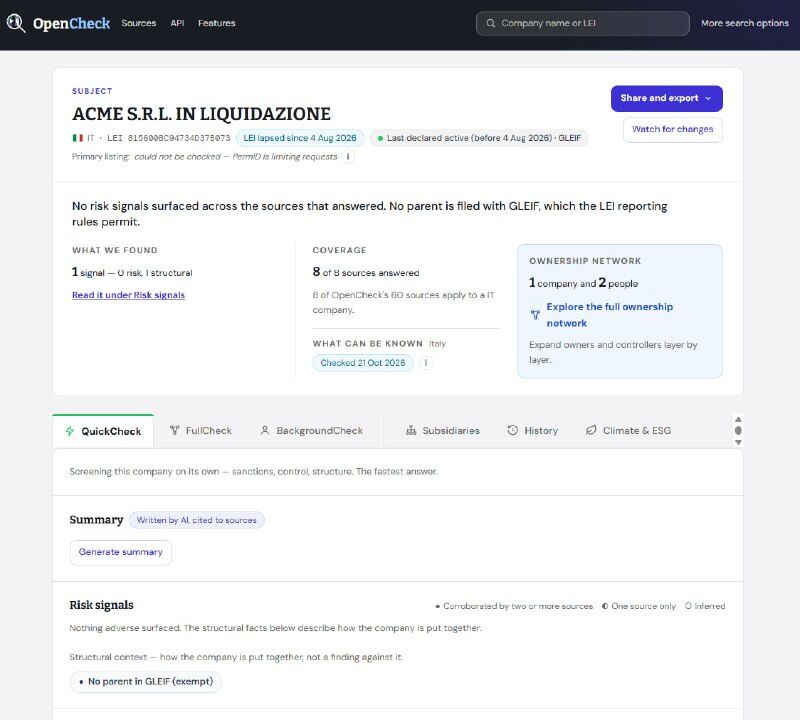
A free company due-diligence tool built around the Legal Entity Identifier (LEI). You start from a company name, LEI, national ID or person…
Leggi tutto
A free company due-diligence tool built around the Legal Entity Identifier (LEI). You start from a company name, LEI, national ID or person name; OpenCheck queries GLEIF, derives every national register number it can, and uses them to pull data from 56 sources into one ownership graph, naming the source behind each finding. Findings are marked as corroborated by two or more sources or as single-source, and include signals such as sanctions, PEP links and state control (screened against OpenSanctions, among others). Results can be exported in many formats, including FollowTheMoney entities for OpenSanctions/OpenAleph workflows, Neo4j and BODS. Everything on the site is also available through a read-only API with no key needed, and the code is on GitHub (https://github.com/StephenAbbott/opencheck). Coverage depends on companies having an LEI and on what each register publishes, so treat gaps as gaps, not as clean results
- theysentit.com
They Sent It
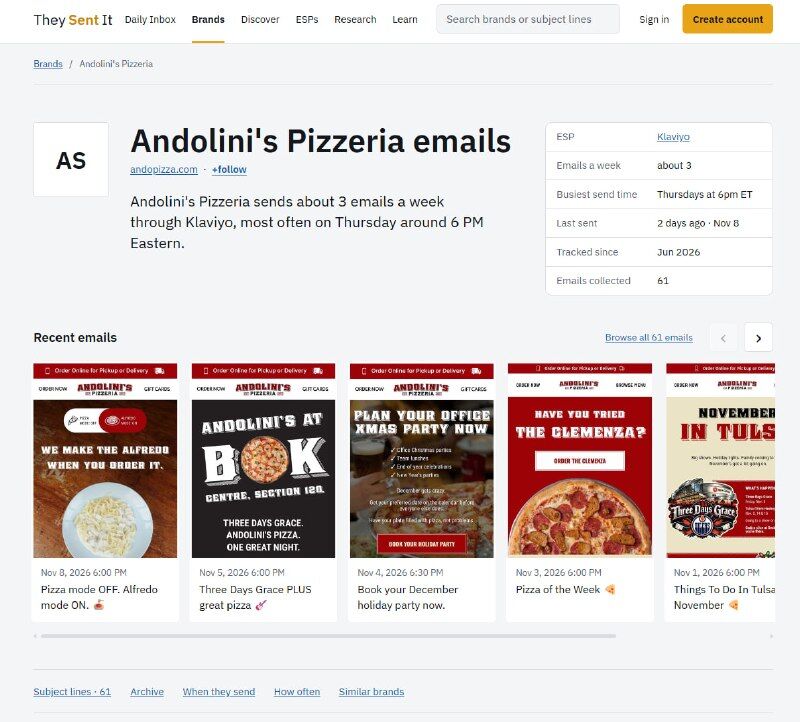
A searchable catalogue of marketing email: about 71,000 brands and over 5.1 million emails from some 188,000 sending domains, with each…
Leggi tutto
A searchable catalogue of marketing email: about 71,000 brands and over 5.1 million emails from some 188,000 sending domains, with each email shown as it rendered plus send time, size and link counts. Brand pages show send schedules, volume, subject lines and the email service provider used, and ESP pages list every brand seen sending through a given platform. For corporate research this can help date campaigns, link brands to sending domains and infrastructure, and recover promotions that have disappeared from a company's website. It is run by an independent company, Unlensed, and states that every page is free to read without an account. Freemium: the site says some future features, such as alerts, will be paid. Coverage is limited to the lists the project has subscribed to. Shared by Cyber Detective.
- map.telesint.dev
Telesint Business map
A free web map of Telegram Business profiles that their owners have made public: business name, address and map point, opening hours, and…
Leggi tutto
A free web map of Telegram Business profiles that their owners have made public: business name, address and map point, opening hours, and the account's name, username, profile photo and ID. According to its privacy page, the map is refreshed every night, each card keeps a history of how the data changed, and a "Hidden" layer keeps the last known data of profiles that were later removed from Telegram. Cyber Detective describes it as covering almost 400K profiles worldwide; we could not check the figure, because the data layer did not load past the site's anti-bot check during our visit. For SOCMINT it links a Telegram username or ID to a declared physical location and to past versions of a profile. OPSEC warning: the site is run by a sole proprietor in Russia and its privacy page says it logs usage statistics, including search texts, so do not type names or details from your own cases into it.
- aocr.org
Getting traffic from aocr.org? That's ByteDance crawling your website
https://tin.computer/blog/aocr-org-referrer-bot By Ege Demir Since late September many sites and GitHub repositories have logged visits…
Leggi tutto
https://tin.computer/blog/aocr-org-referrer-bot By Ege Demir Since late September many sites and GitHub repositories have logged visits "referred" by aocr.org, the site of a US radiology college. This write-up from the web-analytics firm Tin traces that traffic to a crawler using ByteDance's crawler stack. It matches the TLS ClientHello lengths, HTTP/2 priority and Accept header of the declared Bytespider bot (all three appear in only 0.08% of other traffic), carries timing fields named after ByteDance's "forest" resource loader, and WebRTC leaks place its real servers in a China Mobile data-centre network in Shanxi behind rotating US proxies. The authors separate what is confirmed from what is not: they cannot say whether ByteDance itself or a customer of its technology runs it. Beyond the blocking tips, it is a clean worked example of attributing infrastructure through network fingerprints and of stating confidence levels. Note that the post comes from a vendor and includes sales pitches; Soxoj flagged it on his Telegram channel after seeing the same visits on his GitHub.
- osint.industries
How to find social media accounts by email
A guide from OSINT Industries (29 October) on pivoting from an email address to social media profiles. It goes platform by platform…
Leggi tutto
A guide from OSINT Industries (29 October) on pivoting from an email address to social media profiles. It goes platform by platform (Facebook, Instagram, X, LinkedIn, TikTok, Snapchat) and is clear that none of them offers a reliable public lookup by email, so the manual route relies on names, handles and exact-match searches of the address in search engines. The most useful part is the checklist for confirming that several accounts belong to the same person: same photo, distinctive username, consistent dates, cross-linked bios, consistent public details and independent confirmation. It also covers what to try when nothing comes back (aliases, username, phone number) and a short legal and ethics section, including the advice to use account recovery or contact discovery only on accounts you own or are authorised to check. Note that it is vendor content and promotes the company's own lookup tool.
- watched.earth
Watched: every satellite that passed over any place this week
A free web app, no sign-up, that takes any place on Earth and lists the satellites that passed over it in the last seven days, then pulls…
Leggi tutto
A free web app, no sign-up, that takes any place on Earth and lists the satellites that passed over it in the last seven days, then pulls the matching public images from Sentinel-2, Landsat and NASA weather imagery and checks whether the spot was under cloud. The orbit calculations (SGP4 on the CelesTrak catalogue) run in the browser, and the code is public under the MIT licence (https://github.com/dev-Armaan/satellites). Each pass gets one of four labels: "Watched" (a real public photo exists), "Likely watched" (a fixed camera's swath covered the place but no photo is published), "Could have pointed here" (a steerable commercial or radar satellite was in range, with no way to know whether it looked) and "Passed overhead". It is a quick way to see which free imagery exists for a location and date, and to explain to a non-specialist the difference between an overpass and an actual image. It was a Show HN project with 280+ points this week; it is v0.1, so check results against the Copernicus or USGS archives before relying on them.
- benjaminstrick.com
AI Overreach Tracker
By @bendobrown.bsky.social (Benjamin Strick) A dataset of 73 publicly reported cases, from July 2025 to October 2026, in which AI systems…
Leggi tutto
By @bendobrown.bsky.social (Benjamin Strick) A dataset of 73 publicly reported cases, from July 2025 to October 2026, in which AI systems acted beyond their instructions or authorised limits. Each case is summarised and linked to its sources, and classified by boundary crossed (unauthorised access, technical restrictions, unauthorised publication, task scope, coordination), setting, developer and outcome, including how far the action reached: the task environment, the operator's systems, the public internet or another organisation. The tracker states that it counts what is disclosed, not what happens, so cases per developer are not a safety ranking. Useful for analysts working on AI risk and for teams that let agents automate parts of their own collection.
- github.com
Stamped
A new open-source tool from CORRECTIV that checks whether a leaked email is byte-for-byte the message the sending domain signed, by…
Leggi tutto
A new open-source tool from CORRECTIV that checks whether a leaked email is byte-for-byte the message the sending domain signed, by verifying its DKIM signatures offline on the reporter's own machine. Public keys come from a local store you fill yourself, because a DNS lookup would tell the signing domain which of its mail is being examined; fetching missing keys from DNS or archive.prove.email only happens after you confirm the exact domains and selectors. Instead of "valid/invalid" it returns one of six verdicts: confirmed, confirmed with caveats (for example rsa-sha1, short keys, an l= tag or Subject/To/Date not signed), body altered, headers altered, unverifiable and unsigned, and it prints the evidence behind each one. It can also import a whole leaked archive (mbox, Maildir, .eml, folders of mailboxes) and search it locally. The authors describe it as early-stage (CLI plus a desktop window), and "unverifiable" must not be read as proof of forgery. Free, AGPL-3.0; spotted in Scott Klein's Open Journalism roundup.
- osintcombine.com
Beyond Google: Alternative Search Engines for OSINT
By Jemma Ward (OSINT Combine) The article argues that the useful advice is not "use multiple search engines" but "use multiple search…
Leggi tutto
By Jemma Ward (OSINT Combine) The article argues that the useful advice is not "use multiple search engines" but "use multiple search indexes", and explains how crawling, indexing and ranking work before reviewing six alternatives. Each gets a short "good for / not the right choice for" assessment: Qwant and Ecosia (European, privacy-oriented, partly built on mainstream results), self-hosted SearXNG (control over user data and results from several indexes), Marginalia Search (small, non-commercial web, no account), Boardreader (forums and message boards) and Kagi. The background is the uneven reliability of Google's advanced operators in recent months and attribution concerns for investigators. A good refresher for anyone building a search routine that does not depend on a single provider.
- sinocism.com
Sharp China: Parsing the Fifth Plenum; US-China After the Midterms; Nvidia may be in Capitol Hill's Crosshairs…
A free episode of the Sharp China podcast by Bill Bishop (Sinocism) and co-host Andrew. They start from the readouts of the CCP's Fifth…
Leggi tutto
A free episode of the Sharp China podcast by Bill Bishop (Sinocism) and co-host Andrew. They start from the readouts of the CCP's Fifth Plenum: signs that anti-corruption campaigns will continue and may reach retired cadres, and an area of possible convergence with the US on policing corruption carried out through the internet and virtual currencies. They then discuss the US-China outlook after the midterms (the Democrats' China policy, turnover on the China Select Committee, more scrutiny for Nvidia) and close with espionage and cyber items, including a Washington Post report on a new Pentagon deep-cover spy programme aimed at China. Useful for analysts as an example of reading official Chinese readouts for policy signals. Summary based on the published show notes; the audio was not reviewed.
- bellingcat.com
How Online Maps Lay Bare the US Military Bases Targeted by Iran
Bellingcat researcher Sebastian Vandermeersch looks at four US installations hit by Iran's missile and drone campaign (Camp Buehring and…
Leggi tutto
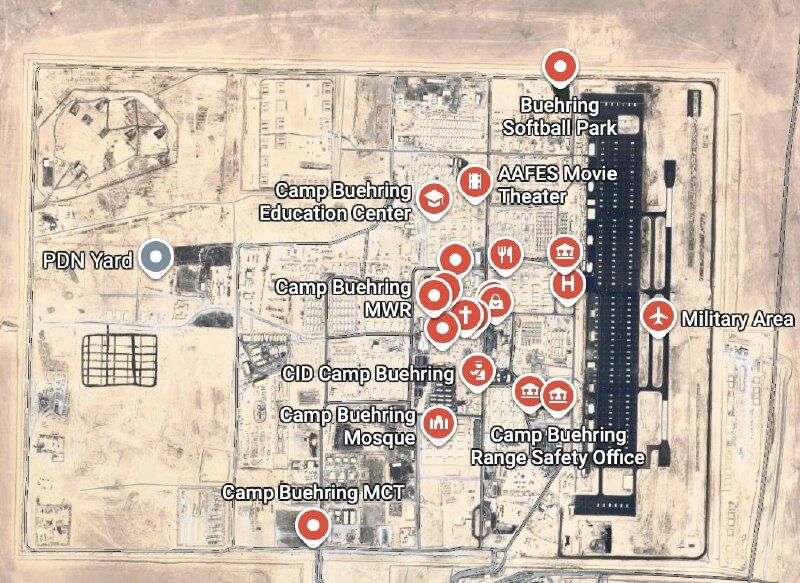
Bellingcat researcher Sebastian Vandermeersch looks at four US installations hit by Iran's missile and drone campaign (Camp Buehring and Camp Arifjan in Kuwait, Muwaffaq Salti Air Base in Jordan, Al Udeid in Qatar) and shows how Google Maps place labels, user reviews and uploaded photos describe headquarters, gyms, accommodation, dining halls and fuel points inside them. The labels were checked against DVIDS photos and against satellite images of the damage published by Iran's Tasnim agency and by The Washington Post (Planet imagery). Where Google's satellite layer is blurred, pasting the coordinates from a Google listing into Bing Maps showed the same facilities unblurred. Reviews also leak patterns of life, such as when a gym is busiest. Useful both as a geolocation case study and as a checklist for OPSEC audits of sensitive sites; the experts quoted stress that Iran also had other intelligence sources. Tools used: – Google Maps labels, reviews and user photos – Bing Maps satellite imagery – DVIDS (US military image archive) – Published satellite imagery of strike damage
- github.com
Instaloader v4.16 (pre-release)
Instaloader is the long-running Python tool for downloading Instagram posts, stories, highlights and profile metadata. Version 4.16 fixes…
Leggi tutto
Instaloader is the long-running Python tool for downloading Instagram posts, stories, highlights and profile metadata. Version 4.16 fixes Profile.get_posts() both with and without login, fixes Profile.from_id() and get_iphone_json(), restructures the JSON-fetching code and adds a progress counter for highlights. It is published as a pre-release, so it has to be installed explicitly with pip3 install –pre –upgrade instaloader. Usual caveats apply: scraping may breach Instagram's terms, and using a logged-in account risks having it flagged, so use a dedicated research account.
- phillipspobrien.substack.com
Weekend Update #209: The Growing Slaughter Of Ukrainian Civilians
By Phillips P. O'Brien O'Brien argues that Russia is deliberately targeting Ukrainian civilians as a strategy, with long-range systems…
Leggi tutto
By Phillips P. O'Brien O'Brien argues that Russia is deliberately targeting Ukrainian civilians as a strategy, with long-range systems hitting trains, buses and apartment blocks and mass-casualty events now weekly. He cites the UN's October report, which counted 2,570 civilians killed through the end of September, already more than in any year of the full-scale war except 2022, and expects indirect deaths to rise as Russia targets power over the winter. The update also covers the evacuation of occupied Oleshky in Kherson oblast and the announced possible sale of Patriot missiles to Ukraine, with deliveries running to 2030. It is an opinion piece with a clear position, useful as a framing of the civilian-harm trend rather than as neutral data.
- novayagazeta.ru
novayagazeta.ru archive in Markdown
https://github.com/novaya-gazeta-ru/archive A GitHub repository that preserves the archive of the Russian edition of Novaya Gazeta, which…
Leggi tutto
https://github.com/novaya-gazeta-ru/archive A GitHub repository that preserves the archive of the Russian edition of Novaya Gazeta, which according to the README announced it will switch off its servers on 9 November 2026. It holds 93,933 articles from 2000-2026 (about 1.1 GB of text and 8.3 GB of images), one Markdown file per article with a header listing source URL, title, date, authors, section and tags, plus the Python scripts used to collect them (standard library only). Links to articles that are not in the archive are rewritten to point at Wayback Machine searches. A ready-made corpus for researchers working on Russia, and a practical example of rapid web archiving before a shutdown. The README does not present it as an official Novaya Gazeta project, so check provenance before citing.
- challenge.bellingcat.com
Bellingcat Challenges 115–117: Creative License series
Three new puzzles from the Bellingcat Volunteer Community, grouped as the "Creative License" series, all tagged Geolocation and Historic…
Leggi tutto
Three new puzzles from the Bellingcat Volunteer Community, grouped as the "Creative License" series, all tagged Geolocation and Historic Research. 115 "Instant Installation" (Bonny Albo) asks for the photographer's position at a sticky-note installation that existed for a single day. 116 "Rendered Rendering" (Livio Spaini) starts from a building shown in a historical video game and asks what its 2018 facade works cost. 117 "Carbon Copy" (Nathan Burke) starts from an old sketch and asks what words are visible on the neighbouring building today, from the same viewpoint. Good practice for transient events and for matching non-photographic sources to real places.
- bellingcat.com
Inside the Secretive, Contradictory World of Campaign Ads Funded by AI Super PACs
By Kolina Koltai Bellingcat traced money from two opposing AI-policy groups through FEC filings to the Super PACs that actually buy the ads…
Leggi tutto
By Kolina Koltai Bellingcat traced money from two opposing AI-policy groups through FEC filings to the Super PACs that actually buy the ads: Leading the Future, funded by OpenAI president Greg Brockman, Andreessen Horowitz and its founders, and Public First Action, a 501(c)(4) funded by Anthropic. It then reviewed more than 300 online video ad campaigns from four of those Super PACs in Google's Ads Transparency Center. Only ads about two candidates mentioned AI, none mentioned data centres, and money from the same networks paid for ads framed as pro- or anti-Trump depending on the audience. A New York Times analysis based on AdImpact data reached similar findings. It is a useful worked example of pairing campaign-finance records with platform ad libraries when the name on an ad is not where the money comes from. Tools used: – FEC filings – Google Ads Transparency Center